
Running a healthcare practice means managing two very different responsibilities at the same time. On one side is patient care, which depends on clinical skill, attention, and time. On the other side is the business of getting paid, which depends on accurate data, strict payer rules, and constant follow-up. When the financial side is handled in pieces by different people, tools, and vendors, small gaps appear between each step, and revenue quietly slips through them.
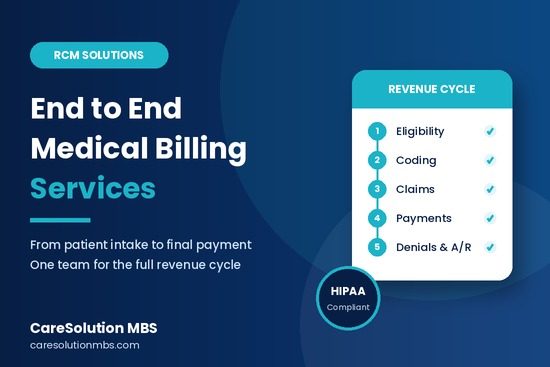
End to end medical billing services close those gaps by placing the entire revenue cycle under one coordinated team. From the moment a patient schedules an appointment to the day the final balance is paid, every step is managed, tracked, and measured as part of one connected process. For many practices, this approach produces faster payments, fewer denials, and far less administrative stress.
This guide explains what end to end medical billing services include, how each stage works, the benefits practices can expect, and what to look for when choosing a provider. Whether you run a solo practice, a growing group, or a specialty clinic, the sections below will help you decide whether a complete billing solution is the right fit.
What Are End to End Medical Billing Services?
End to end medical billing services are comprehensive outsourcing solutions in which a single billing company manages every stage of a practice’s revenue cycle. Instead of handling only claim submission or only collections, the billing partner takes responsibility for the entire financial journey of each patient encounter.
In practical terms, this usually includes eligibility verification, prior authorization, medical coding, charge entry, claim scrubbing and submission, payment posting, denial management, accounts receivable follow-up, patient billing, and financial reporting. Many providers also include credentialing and payer enrollment, since a provider who is not properly enrolled cannot be paid regardless of how well claims are prepared.
The defining feature is ownership. With end to end service, the billing company is accountable for outcomes across the whole cycle rather than for a single task. When a claim is denied, the team does not simply note the denial and pass it along. It identifies whether the cause began at registration, coding, or submission, fixes the problem at its source, and recovers the payment. This connected view is what separates a complete billing solution from a collection of disconnected services.
End to end services are available to almost every type of provider, including independent physicians, multispecialty groups, ambulatory surgery centers, laboratories, imaging centers, and behavioral health practices. The scope can be tailored to each practice, but the principle stays the same: one team, one process, and one point of accountability for the entire revenue cycle.
How End to End Billing Differs from Partial Outsourcing
Many practices begin by outsourcing one piece of their billing, such as coding or old accounts receivable. Partial outsourcing can help, but it often creates handoff problems. When the front desk verifies eligibility, an internal biller enters charges, an outside coder assigns codes, and another vendor follows up on unpaid claims, no single party sees the full picture.
These handoffs create blind spots. A coding vendor may not know that eligibility was never confirmed. A collections vendor may keep appealing a denial that actually stems from a registration error. Each party completes its own task, yet the practice still loses revenue because no one owns the result.
End to end medical billing services remove those blind spots. One team sees every step, uses consistent processes, and works from the same data. Problems that appear late in the cycle can be traced back and corrected early, which prevents the same errors from repeating. Communication is simpler too, because the practice has one point of contact rather than several vendors with different reporting formats and priorities.
Partial outsourcing still makes sense in some situations, such as a large organization with a strong internal team that needs help with a specific backlog. For most small and mid-sized practices, however, a complete solution delivers more consistent results.
Patient Scheduling, Registration, and Eligibility Verification
The revenue cycle begins before the patient arrives. Accurate registration is the foundation for every claim, because errors in names, dates of birth, member numbers, or insurance details are among the most frequent causes of rejected claims.
In an end to end model, the billing team works with the front office to make sure demographic and insurance information is captured completely and correctly. This includes collecting images of insurance cards, confirming subscriber details, and identifying primary and secondary coverage.
Eligibility verification follows. Before each scheduled visit, the team confirms that the patient’s coverage is active and identifies copays, deductibles, coinsurance, and any plan limitations. Verifying a few days in advance allows time to resolve problems, such as terminated coverage or a change in plan, before the patient is seen.
This front-end work has a direct financial impact. When staff know exactly what a patient owes, they can collect copays and outstanding balances at check-in. Patients also appreciate clear information about their costs before treatment rather than surprise bills weeks later. Strong front-end processes prevent many denials from ever happening, which is far more efficient than fixing them afterward.
Prior Authorization and Referral Management
Many payers require approval before they will cover certain services, including advanced imaging, specialty procedures, surgeries, durable medical equipment, and some medications. If a required authorization is missing, the claim is usually denied, and recovering payment after the fact is difficult.
End to end medical billing services include tracking which services need authorization for each payer, submitting requests with the required clinical documentation, and following up until a decision is made. The team records authorization numbers, approved units, and expiration dates so that claims match the approval exactly.
Referral management works in a similar way. Some plans, particularly HMOs, require a referral from a primary care provider before a patient can see a specialist. Missing or expired referrals lead to denials that have nothing to do with the quality of care provided.
Because authorization rules change frequently and differ between payers, this work benefits from a dedicated team that handles it every day. Coordinating authorizations with scheduling also helps practices avoid last-minute cancellations, keeping provider calendars full and patients informed.
Medical Coding and Charge Entry
Medical coding converts clinical documentation into standardized codes that payers use to process claims. CPT codes describe the services performed, ICD-10-CM codes describe the diagnoses that justify them, and HCPCS Level II codes cover certain supplies, drugs, and services. Modifiers add important context, such as indicating a distinct procedure or a bilateral service.
Accurate coding is one of the most important parts of any billing solution. Undercoding leaves earned revenue unclaimed, while overcoding creates compliance risk and invites audits. End to end providers assign experienced coders who understand the specialty they support, since cardiology, orthopedics, behavioral health, and laboratory billing each follow their own rules.
Charge entry follows coding. Each service must be entered with the correct codes, units, dates, provider, and place of service. A complete billing team also reconciles scheduled appointments against documented encounters and posted charges, which ensures that no billable service is missed.
When documentation does not fully support a code, coders should query the provider clearly and respectfully. This feedback improves documentation over time, strengthens medical necessity, and protects the practice if claims are ever reviewed.
Claim Scrubbing and Submission
Before a claim leaves the practice, it should be checked for errors that would cause rejection or denial. This process, known as claim scrubbing, compares each claim against payer rules, coding edits, and formatting requirements.
Common issues caught during scrubbing include missing or invalid provider identifiers, mismatched diagnosis and procedure codes, missing modifiers, incorrect place-of-service codes, and invalid dates. Automated tools flag many of these problems, but experienced billers are needed to review flagged claims and correct them properly.
Once claims pass review, they are submitted electronically through a clearinghouse to the appropriate payer. End to end billing teams submit claims promptly, monitor acknowledgment and rejection reports daily, and correct rejected claims quickly. A claim that never reaches the payer cannot be paid, so this monitoring step is essential. For paper claims, which some smaller payers still require, the team prepares accurate forms, tracks mailing dates, and follows up to confirm receipt. Keeping a clear record of every submission also helps if a payer later disputes when a claim was filed.
Timely submission also protects against filing deadlines. Every payer sets a timely filing limit, and claims submitted after that deadline may be denied permanently. A complete billing solution tracks these limits and ensures that every claim is filed well within them. The goal is a high first-pass acceptance rate, meaning most claims are accepted and processed without additional work.
Payment Posting and Reconciliation
When payers process claims, they send payments along with remittance details explaining how each claim was handled. Payment posting records these payments against the correct patient accounts and service lines in the practice management system.
Accurate posting is essential for understanding the financial position of the practice. Each line should reflect the allowed amount, payment, contractual adjustment, and patient responsibility. During posting, the billing team also identifies denials, partial payments, and underpayments, then routes them for follow-up rather than leaving them unnoticed.
Reconciliation confirms that posted payments match actual deposits. The team compares posted totals against bank deposits and electronic funds transfer records to identify missing remittances, misapplied payments, or payer errors.
Posting also supports underpayment detection. When a payer reimburses below the contracted rate, the difference on a single claim may seem small, but the total across many claims can be significant. End to end billing teams compare payments against fee schedules and pursue corrections when payers fall short. This level of detail is difficult for busy in-house staff to maintain consistently.
Denial Management and Appeals
Even well-prepared claims are sometimes denied. What matters is how quickly and effectively those denials are handled. Denials that are left unworked become permanent losses, even when the practice has every right to payment.
In an end to end model, every denial is reviewed and categorized by cause. Some require a simple correction and resubmission, such as fixing a modifier or updating patient information. Others require a formal appeal supported by medical records, letters of medical necessity, or authorization documentation. Appeals are filed within payer deadlines and tracked until they are resolved.
The greater value comes from prevention. Because the same team handles every stage of the revenue cycle, it can trace each denial back to its source. Repeated eligibility denials point to front-desk verification gaps. Recurring medical necessity denials may indicate documentation or coding issues. Fixing the underlying process prevents future denials, which saves far more time and money than appealing them one by one.
Practices should receive regular reports showing top denial reasons, the payers involved, and the amounts at stake, so they can see exactly where improvements are happening.
Accounts Receivable Follow-Up and Recovery
Accounts receivable represents money owed for services already delivered. The longer a balance remains unpaid, the harder it becomes to collect. Consistent follow-up is therefore a core part of end to end medical billing services.
The billing team works the aging report systematically, prioritizing high-value claims and those approaching filing limits. Follow-up includes checking claim status through payer portals, calling payers when necessary, supplying requested records, and escalating claims that have stalled without explanation.
Key measures include days in accounts receivable and the percentage of balances older than ninety days. When these numbers rise, the team investigates whether the cause lies with a particular payer, service, or internal process, and then takes corrective action.
Many practices also carry older balances from before they outsourced. End to end providers often offer A/R recovery projects that review aged accounts, identify which remain collectible, and pursue them before deadlines pass. Recovering even part of these balances can provide a meaningful boost to cash flow during the transition to a new billing partner.
Patient Billing and Collections Support
Patients are now responsible for a larger share of their healthcare costs, largely because of high-deductible health plans. Collecting patient balances has become a significant part of revenue cycle management and requires a careful approach that protects patient relationships.
End to end billing services include generating clear, accurate patient statements that show what was billed, what insurance paid, and what the patient owes. Statements are sent on a consistent schedule, with reminders for overdue balances. Clear statements reduce confusion and encourage prompt payment.
Many providers also offer patient support lines where trained staff answer billing questions courteously. Convenient payment options, such as online payments and payment plans, make it easier for patients to settle their balances.
All patient billing activity should follow the practice’s financial policies and applicable regulations. Before any account is sent to an outside collection agency, the billing team should coordinate with the practice. Handled well, patient billing improves collections while preserving the trust patients place in their providers.
Credentialing, Compliance, and Financial Reporting
A complete billing solution extends beyond claims. Credentialing and payer enrollment ensure that providers are approved to bill each insurance company in the first place. End to end providers prepare applications, maintain CAQH profiles, track application status, and monitor recredentialing and revalidation deadlines so that billing is never interrupted.
Compliance runs through every stage of the revenue cycle. A billing company handling protected health information is a business associate under HIPAA and must sign a business associate agreement. It must also maintain safeguards such as access controls, encryption, staff training, and secure data transmission. Beyond privacy, a responsible billing partner follows coding guidelines and payer rules, refusing practices such as upcoding or unbundling.
Financial reporting ties everything together. Practices should receive regular reports covering charges, payments, adjustments, collections, denial trends, first-pass acceptance rates, and accounts receivable aging. The best partners explain what the numbers mean and recommend specific actions. Access to real-time dashboards allows practice owners to monitor performance at any time rather than waiting for month-end summaries.
Benefits of End to End Medical Billing Services
The most immediate benefit is stronger, more predictable cash flow. When every stage of the revenue cycle is managed carefully, claims are paid faster, fewer are denied, and fewer balances age into write-offs. Practices gain a clearer picture of their finances and can plan with greater confidence.
Lower operating costs are another advantage. Building an in-house billing department requires hiring, training, software, and ongoing education as rules change. Staff turnover can disrupt collections for weeks. Outsourcing to a complete billing team replaces these fixed costs with a predictable service arrangement and provides continuity that does not depend on one or two employees.
End to end services also reduce compliance risk, since experienced coders and billers stay current with code updates and payer policies. Providers and staff spend less time on paperwork and phone calls, giving them more time for patients.
When choosing a provider, practices should look for specialty experience, HIPAA-compliant processes, compatibility with their practice management system, transparent reporting, clear pricing, and a dedicated point of contact. Asking for references and reviewing sample reports can reveal how a provider actually performs.
It is also wise to ask how the transition will work. A good provider will explain how it handles open claims, existing accounts receivable, and system access during onboarding, and it will set clear expectations for the first ninety days so that cash flow continues without interruption.
How CareSolution MBS Delivers End to End Medical Billing Services
CareSolution MBS has supported healthcare providers across the USA for more than a decade with complete revenue cycle management built around accuracy, compliance, and clear communication. Our team manages every stage of the billing process, from eligibility verification and prior authorization through coding, claim submission, payment posting, denial management, accounts receivable follow-up, and patient billing support.
We serve a wide range of specialties, including cardiology, dermatology, gastroenterology, neurosurgery, pathology, radiology, clinical laboratories, and dental practices. We also provide credentialing services to keep providers enrolled and billing without interruption. Our team works within leading practice management systems such as athenahealth, AdvancedMD, DrChrono, eClinicalWorks, Tebra, and CureMD, so your staff can keep using the tools they already know.
Every client receives a dedicated account manager, detailed financial reporting, and HIPAA-compliant workflows that protect patient information at every step. If your practice is ready to replace fragmented billing with one accountable team, contact CareSolution MBS to schedule a free consultation and see how our end to end medical billing services can strengthen your revenue cycle.


