
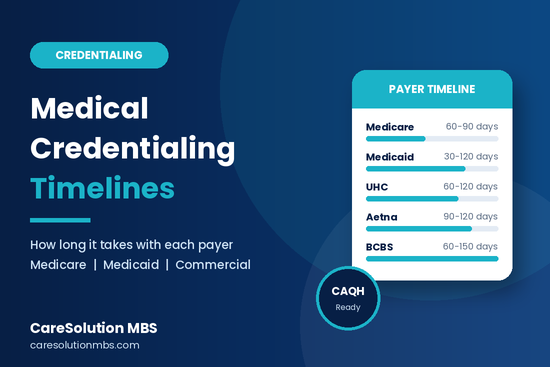
Overview of Medical Credentialing Timelines
Every new provider who joins a practice faces the same frustrating question: when can they start billing insurance? The answer depends almost entirely on medical credentialing, the process through which insurance companies verify a provider’s qualifications and approve them to join their networks. Until that approval arrives, claims submitted under the provider’s name are likely to be denied or paid at out-of-network rates, if they are paid at all.
The challenge is that there is no single timeline. Medicare, Medicaid, and each commercial insurer run their own processes, use their own forms, and move at their own pace. A clean Medicare application might be approved in a few weeks, while a commercial plan in a busy market can take four or five months. Practices that do not plan for these differences often end up with providers who are seeing patients but generating little or no reimbursable revenue.
This guide explains medical credentialing timelines payer by payer, breaks down the stages that drive those timelines, and offers practical strategies for getting providers approved and billing as quickly as possible. The ranges below reflect typical industry experience and published contractor guidance, but individual results always vary by state, specialty, and the completeness of the application.
What Medical Credentialing Involves
Medical credentialing is the process of verifying that a healthcare provider has the education, training, licensure, and professional history required to deliver care. Payers use credentialing to protect patients and to meet accreditation standards, such as those set by the National Committee for Quality Assurance. Hospitals perform a similar review, often called privileging, before allowing a provider to treat patients in their facilities.
Payer enrollment is closely related but slightly different. Credentialing confirms that the provider is qualified. Enrollment, sometimes called contracting, establishes the business relationship that allows the provider to bill the payer as an in-network participant. In everyday conversation, practices use the terms interchangeably, but both steps must be complete before claims will pay at network rates.
The information reviewed during credentialing typically includes medical school and residency records, state medical licenses, DEA and state controlled substance registrations, board certification, malpractice insurance and claims history, work history with explanations for any gaps, hospital affiliations, and any history of sanctions or disciplinary action. Each item must be verified, which is one of the main reasons the process takes time.
Why Credentialing Timelines Matter for Practice Revenue
Credentialing delays have a direct and measurable cost. A physician who joins a practice and waits four months for commercial approval may see dozens of patients each week during that period. If those patients have plans the provider is not yet credentialed with, the practice either has to reschedule them with another provider, absorb the cost of unpaid visits, or turn them away.
Delays also create downstream billing problems. Claims submitted before an effective date are usually denied, and some payers will not allow retroactive billing at all. Even when retroactive billing is permitted, the window is limited, so claims held too long may become unbillable. Practices that track credentialing carefully can schedule new providers with patients whose coverage is already approved, protecting revenue while other applications finish.
Finally, credentialing affects recruitment and patient access. A practice known for slow onboarding may struggle to attract providers, and patients who cannot be seen by their preferred clinician may look elsewhere. Understanding realistic timelines allows practices to plan start dates, schedules, and budgets with confidence.
The Main Stages of the Credentialing Process
Although every payer runs its own process, most credentialing follows the same general sequence. Knowing where time is spent at each stage helps practices identify where delays are likely to occur.
Application Preparation and CAQH Profile
The process begins with gathering documents and completing applications. Most commercial payers rely on CAQH ProView, a centralized database where providers store their credentialing information. Payers pull data from CAQH rather than collecting it separately, but only if the profile is complete, accurate, and recently attested. Providers must reattest every 120 days. Preparing a complete file typically takes one to three weeks, depending on how quickly the provider supplies documents.
Primary Source Verification
Once a payer receives the application, it verifies each credential directly with the original source. This means contacting medical schools, residency programs, licensing boards, and certification bodies, and querying databases such as the National Practitioner Data Bank. Verification often takes several weeks, and any slow response from a source can stall the entire file.
Credentialing Committee Review
After verification, the file goes to the payer’s credentialing committee for a decision. Many committees meet monthly, so an application completed just after a meeting may wait several weeks for the next one. Files with malpractice claims, licensing issues, or unexplained work gaps may receive additional scrutiny.
Contracting and System Loading
Approval is not the final step. The payer must issue a participation agreement, which the practice signs and returns, and then load the provider into its claims system. This loading step can take an additional two to six weeks, and claims submitted before it is complete may still deny. Practices should always confirm the effective date in writing before billing.
Medicare Credentialing Timeline
Medicare enrollment is handled by Medicare Administrative Contractors, regional companies that process applications on behalf of the Centers for Medicare and Medicaid Services. Most individual physicians and non-physician practitioners enroll using the CMS-855I application, and groups use the CMS-855B. Providers joining a group also complete a reassignment so that payments flow to the group.
PECOS Versus Paper Applications
Medicare applications can be submitted online through the Provider Enrollment, Chain, and Ownership System, known as PECOS, or on paper. Online applications are consistently faster. Published contractor guidance shows that PECOS applications without a site visit are commonly processed in roughly 15 to 50 calendar days, while paper applications without a site visit take roughly 30 to 65 days. In practice, many providers find that the full process, including any requests for additional information, takes about 60 to 90 days.
Site Visits and Requests for Information
Some provider types and practice locations require a site visit before approval. When a visit is needed, processing times extend significantly, often into the range of 50 to 85 days for online applications and longer for paper. If the contractor sends a request for additional information, the provider generally has 30 days to respond. Missing that deadline can lead to rejection, which means starting over.
Effective Dates and Retroactive Billing
Medicare offers an advantage that many commercial payers do not. Once approved, physicians and certain other practitioners can typically bill for services provided up to 30 days before the date the contractor received the application, as long as they met all program requirements on those dates. This makes it important to submit the Medicare application as early as possible and to hold claims for the new provider until approval is confirmed.
Medicaid Credentialing Timeline
Medicaid is administered by each state, so credentialing timelines vary more than for any other payer type. Some states process clean applications within a few weeks, while others routinely take several months. Each state has its own portal, forms, fees, and documentation requirements.
State Fee-for-Service Enrollment
The first step is enrolling directly with the state Medicaid agency. Typical processing ranges from about 30 to 120 days, depending on the state, the provider type, and whether a site visit or fingerprint-based background check is required. Under federal rules, ordering, referring, and prescribing providers must also be enrolled with the state, even if they do not bill Medicaid directly.
Medicaid Managed Care Plans
In most states, a large share of Medicaid members are enrolled in managed care organizations rather than traditional fee-for-service Medicaid. Each of these organizations runs its own credentialing process, which often adds another 60 to 120 days or more after state enrollment. Federal rules allow managed care plans to execute provisional network agreements for up to 120 days while a provider’s state enrollment is pending, but plans apply this option differently. Practices in managed-care-heavy states should expect full Medicaid participation to take four to six months.
Commercial Payer Timelines at a Glance
Commercial insurers set their own credentialing timelines, and those timelines can change based on application volume, network needs, and local market conditions. The ranges below reflect commonly reported experience for complete applications with a current CAQH profile.
UnitedHealthcare: Typical credentialing runs about 60 to 120 days. Timelines tend to be shorter when the CAQH profile is complete and attested, and longer in high-demand markets or for specialties where the network is already full.
Aetna: Most applications are completed in roughly 90 to 120 days, with some taking up to 150 days. Providers joining groups with delegated credentialing arrangements may move faster, since the group performs much of the verification.
Cigna: Credentialing commonly takes about 60 to 120 days. In some areas, Cigna may close its network to certain specialties, which means an application may be declined regardless of the provider’s qualifications.
Blue Cross Blue Shield plans: Because each Blue plan operates independently by state or region, timelines range widely, often from 60 to 150 days or more. Some plans also require separate applications for different product lines, such as commercial, Medicare Advantage, and Medicaid.
Humana: Timelines commonly fall in the 90 to 120 day range. Humana’s significant Medicare Advantage business means providers often complete credentialing for both commercial and Medicare Advantage products at the same time.
Regional and smaller commercial plans: Smaller insurers often process applications in about 45 to 90 days, although some rely on manual processes that create unpredictable delays.
Remember that approval from one payer has no effect on another. Each commercial insurer requires its own application and its own review, so practices should submit to all major payers at the same time rather than one after another.
Medicare Advantage and Other Government Programs
Medicare Advantage plans are offered by private insurers under contract with the federal government. A provider enrolled in traditional Medicare is not automatically in network with any Medicare Advantage plan. Each plan requires separate credentialing, and because these plans combine federal requirements with the insurer’s own process, timelines often fall in the 90 to 150 day range.
TRICARE, the health program for military service members and their families, is administered through regional contractors. Providers credential with the contractor serving their region, and timelines vary by region and network demand. Practices near military installations often find TRICARE participation worthwhile, but they should plan for a process similar in length to commercial credentialing.
Practices that serve veterans may also participate in the community care networks used by the Department of Veterans Affairs. These networks are managed by third-party administrators, each with its own credentialing requirements. As with other payers, completing the application accurately and keeping documents current is the most reliable way to avoid delays.
Factors That Slow Credentialing Down
Even when payers publish target timelines, many applications take far longer than expected. The most common causes of delay are predictable and, in many cases, preventable.
Incomplete applications: Missing signatures, blank fields, and absent attachments are the leading cause of delays. Payers often pause the file and send a request for information, which can add weeks each time.
Outdated or unattested CAQH profiles: If a provider’s CAQH profile has expired or contains old information, payers cannot pull the data they need. Simply reattesting can restart a stalled application.
Unexplained gaps in work history: Most payers require explanations for gaps longer than a few months. Missing explanations prompt follow-up questions and slow committee review.
Mismatched information: Differences between the address, tax identification number, or practice name listed on the application and the information in payer or federal records cause rejections and rework.
Expired licenses or certificates: Any document that expires during the review, such as a malpractice certificate or DEA registration, can halt processing until an updated copy is submitted.
Closed networks: When a payer has enough providers in a specialty and region, it may decline new applications or place them on a waiting list, regardless of how complete they are.
Lack of follow-up: Applications that are submitted and then forgotten frequently stall without notice. Regular status checks are essential for keeping files moving.
Timelines for Individual Providers Versus Groups
The type of enrollment being requested also influences how long credentialing takes. Practices should understand which situation applies before setting expectations with new providers.
Individual Providers Joining an Established Group
Adding a provider to a group that is already contracted with a payer is usually the fastest scenario. The group’s agreement is already in place, so the payer only needs to credential the new provider and link them to the existing contract. Many of these additions are completed within the typical ranges described above.
New Group Practices and Facilities
A brand-new practice must first establish its own group enrollment and contract with each payer before individual providers can be linked. This adds a full additional layer of review, and some payers will not credential individual providers until the group contract is final. New practices should begin the process at least four to six months before opening.
Changes of Ownership or Location
When a practice changes ownership, tax identification number, or location, payers must update their records. Some updates are simple, but changes of ownership may require new applications and new contracts. Failing to report changes on time can cause claims to deny or payments to be sent to the wrong entity.
Recredentialing and Revalidation Timelines
Credentialing is not a one-time task. Payers periodically review every provider in their network to confirm that credentials remain current. Under NCQA standards followed by most commercial payers, recredentialing occurs at least every 36 months. Practices usually receive notice in advance, and the process is typically shorter than initial credentialing because much of the information is already on file.
Medicare requires providers to revalidate their enrollment, generally every five years for most providers and suppliers. CMS posts revalidation due dates in advance, and contractors send notices, but practices remain responsible for completing revalidation on time. Missing a revalidation deadline can result in deactivation of billing privileges, which interrupts payment until the issue is resolved.
Medicaid programs also require periodic revalidation, often every three to five years, depending on the state. Tracking all of these deadlines across multiple providers and payers is one of the most demanding parts of credentialing management, and it is where many practices benefit from dedicated support.
How to Shorten Your Credentialing Timeline
Practices cannot control how quickly payers work, but they can control the quality and timing of their own submissions. These strategies consistently reduce time to approval.
Start early: Begin credentialing 90 to 120 days before a provider’s start date, and earlier for new practices. Collecting documents during the hiring process prevents a slow start.
Keep CAQH current: Complete the CAQH profile in full, upload all supporting documents, authorize payer access, and reattest on schedule so that payers can pull information without delay.
Submit to payers in parallel: File Medicare, Medicaid, and commercial applications at the same time. Waiting for one approval before starting the next can add months to the total timeline.
Use PECOS for Medicare: Online submissions are processed faster than paper applications and allow real-time status tracking.
Use a checklist for every application: A standard checklist covering licenses, certificates, signatures, and attachments reduces the chance of returned applications.
Follow up on a schedule: Check application status every one to two weeks, record reference numbers and contact names, and respond to information requests the same day whenever possible.
Confirm effective dates in writing: Before billing for a new provider, obtain written confirmation of the effective date and confirm that the provider is loaded in the payer’s claims system.
Common Mistakes That Add Months to Credentialing
Beyond the routine delays described earlier, some mistakes can set a practice back by months. One of the most common is allowing a new provider to see patients under another provider’s billing number while waiting for credentialing. This practice generally violates payer rules and can create serious compliance risk. Any interim billing arrangement should be reviewed carefully against each payer’s policies.
Another costly mistake is assuming that approval with one payer covers related products. Credentialing with a commercial plan does not automatically include its Medicare Advantage or Medicaid products, and enrollment in traditional Medicare does not include Medicare Advantage plans. Each requires confirmation.
Practices also lose time by relying on a single staff member who handles credentialing alongside many other duties. When that person is out or leaves, applications stall and deadlines are missed. Finally, failing to keep copies of submissions, confirmation numbers, and payer correspondence makes it difficult to prove when an application was received, which can affect effective dates and appeals.
How CareSolution MBS Speeds Up Medical Credentialing
Medical credentialing timelines are shaped by payers, but a well-managed process can remove much of the avoidable delay. CareSolution MBS provides credentialing and payer enrollment services for physicians, group practices, and specialty providers across the USA as part of its complete revenue cycle management solutions.
Our credentialing team prepares complete applications, builds and maintains CAQH profiles, submits Medicare enrollments through PECOS, and handles state Medicaid and managed care applications alongside commercial payer submissions. We file applications in parallel, track every file on a regular follow-up schedule, and respond quickly to payer requests. We also monitor recredentialing and revalidation deadlines so that providers remain active without interruption.
Because credentialing connects directly to billing, our team coordinates effective dates with claim submission, helping practices avoid denials for providers who are not yet loaded in payer systems. If you are onboarding new providers, opening a new location, or struggling with stalled applications, contact CareSolution MBS for a free consultation and a clear plan to get your providers credentialed and billing sooner.


