
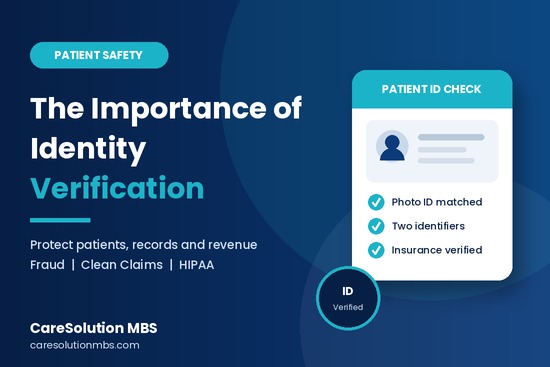
Every patient encounter begins with a simple question: who is this person? In most cases, the answer seems obvious. A patient arrives, gives a name and date of birth, hands over an insurance card, and the visit moves forward. Yet behind that routine moment sits one of the most important safeguards in healthcare. When identity is not confirmed correctly, the consequences can include denied claims, corrupted medical records, fraudulent billing, privacy violations, and even clinical harm.
The importance of identity verification has grown as healthcare has become more digital. Patient portals, telehealth visits, electronic records, and online payments make care more convenient, but they also create new opportunities for mistakes and fraud. Medical identity theft, in which someone uses another person’s information to obtain care or file claims, can follow a victim for years and leave providers with unpaid bills and compliance headaches.
This guide explains why identity verification matters, how it affects patients, providers, and the revenue cycle, which regulations apply, and what practical steps practices can take to build a reliable verification process without slowing down patient care.
What Is Patient Identity Verification?
Patient identity verification is the process of confirming that a person seeking care is who they claim to be, and that their information matches the correct medical record and insurance coverage. It typically involves checking a government-issued photo ID, confirming demographic details, reviewing the insurance card, and comparing this information with existing records.
Verification is different from simple identification. Identification happens when a patient states their name. Verification happens when that statement is confirmed against reliable evidence. A strong process does both at every appropriate point in the patient journey, from scheduling and registration to the moment care is delivered and the claim is billed.
In healthcare, identity verification serves several purposes at once. It protects patients from fraud, keeps clinical records accurate, supports correct billing, and helps practices meet privacy and security obligations.
Why Identity Verification Matters in Healthcare
Healthcare data is among the most sensitive information a person has. A medical record contains names, addresses, dates of birth, insurance numbers, and often Social Security numbers, along with diagnoses, medications, and treatment history. This combination makes healthcare identities especially valuable to criminals and especially damaging when misused.
Unlike a stolen credit card, which can be canceled and replaced, medical information cannot simply be reset. A false diagnosis added to a record or a fraudulent claim filed under a patient’s insurance can be difficult to discover and even harder to correct.
For providers, the stakes are financial, legal, and clinical. Incorrect identification leads to denied claims, duplicate records, and wasted staff time. It can also expose a practice to regulatory scrutiny if patient information is disclosed to the wrong person. Most importantly, treating a patient based on someone else’s record can result in serious harm.
Understanding Medical Identity Theft
Medical identity theft occurs when someone uses another person’s identifying information, such as a name, insurance member number, or Medicare number, to obtain medical services, prescriptions, equipment, or insurance payments. It can be committed by individuals seeking care they cannot afford, by organized fraud schemes, or occasionally by insiders with access to patient data.
Common forms include presenting a stolen or borrowed insurance card at a clinic, using stolen information to obtain prescription drugs, and submitting fraudulent claims for services that were never provided.
Medical identity theft is particularly difficult to detect because victims may not notice anything unusual until they receive a bill for care they never received, are denied coverage because benefits have been used, or find unfamiliar entries in their medical record.
How Medical Identity Theft Affects Patients
For patients, the effects of medical identity theft go beyond money. When someone else receives care under a victim’s name, that person’s diagnoses, allergies, blood type, and medications may be added to the victim’s record. Later, a clinician relying on that record could make treatment decisions based on information that does not belong to the patient.
Victims may also face financial consequences, including bills for services they did not receive, collection notices, and damaged credit. Insurance benefits can be exhausted by fraudulent claims, leaving victims with reduced coverage when they genuinely need care.
Correcting the damage is often slow and frustrating. Patients may need to contact multiple providers and insurers, request copies of records, and dispute entries one by one. Strong identity verification at the provider level is one of the most effective ways to prevent these problems before they begin.
How Medical Identity Theft Affects Providers
Providers suffer real losses when identity verification fails. If a practice treats someone using another person’s insurance and the fraud is later discovered, the payer may deny or recover payment. The practice is then left with an unpaid service and little chance of collecting from the person who actually received care.
Fraud also creates administrative burdens. Staff must investigate disputed claims, separate merged records, respond to patient complaints, and coordinate with insurers. These tasks take time away from normal billing work and can delay legitimate revenue.
There are reputational and compliance risks as well. Patients who discover fraudulent activity associated with a practice may lose trust in that provider, even if the practice did nothing wrong. Practices that cannot show a consistent verification process may also face more difficult questions from payers and regulators when problems arise.
The Link Between Identity Verification and Clean Claims
Identity verification is closely tied to billing accuracy. Insurance companies match each claim to a specific member using the patient’s name, date of birth, and member identification number. If any of these details are wrong, the claim may be rejected before it is even reviewed.
Simple errors, such as a misspelled last name, a reversed date of birth, a missing suffix, or an outdated member number, are among the most common causes of front-end claim rejections.
When front-office staff verify identity carefully and confirm that demographic information matches the insurance card exactly, claims are far more likely to be accepted on the first submission. In this sense, identity verification is not only a security measure but also a core part of clean claim preparation.
Identity Verification and Insurance Eligibility
Eligibility verification confirms that a patient’s insurance coverage is active and identifies what the plan will pay. This process depends entirely on accurate identity information. If the patient’s details do not match the payer’s records, eligibility checks may return errors or, worse, information about the wrong person.
Verifying identity before checking eligibility helps practices confirm that the coverage being reviewed actually belongs to the patient in front of them. It also helps identify situations in which a patient presents someone else’s card, such as a family member’s, either by mistake or intentionally.
Combining identity verification with eligibility checks allows staff to identify coverage changes, secondary insurance, and plan terminations before the visit. This protects both the patient and the practice from unexpected denials and surprise bills after care has been delivered.
Preventing Duplicate and Overlaid Medical Records
Duplicate records occur when a single patient has two or more separate records in a practice or health system. This often happens when staff cannot find an existing record because of a spelling variation or data entry error and create a new one instead. Overlaid records are the opposite problem: information from two different patients is mistakenly combined into one record.
Both issues create clinical and financial risk. Duplicate records split a patient’s history across multiple files, so clinicians may not see important allergies, test results, or prior treatments. Billing can also be affected, because charges and payments may be posted to the wrong record. Overlaid records are even more dangerous, since one patient’s information may guide another patient’s care.
Consistent identity verification at registration, including searching for existing records using multiple identifiers, greatly reduces both problems. Regular reviews of potential duplicates help keep the master patient index clean and reliable.
Protecting Patient Safety Through Accurate Identification
Accurate identification is a foundation of patient safety. Medication errors, wrong-patient procedures, and mismatched test results can all occur when identity is not confirmed at key moments of care.
The Joint Commission’s National Patient Safety Goals call for using at least two patient identifiers, such as name and date of birth, when providing care, treatment, or services.
While this standard focuses on clinical activities, the same principle applies to administrative work. Using multiple identifiers when scheduling, registering, posting charges, and releasing records helps ensure that every action is linked to the right person. Practices that build this habit into daily workflows protect patients clinically while also improving billing accuracy.
Regulatory Requirements and the FTC Red Flags Rule
Several regulations influence how healthcare organizations approach identity verification. One of the most discussed is the Federal Trade Commission’s Red Flags Rule, which requires certain creditors to maintain a written program for detecting and responding to warning signs of identity theft.
Whether a healthcare provider is covered depends on its billing and payment practices. Following clarifying legislation in 2010, the rule generally applies to creditors that regularly obtain credit reports, report to credit bureaus, or advance funds to customers. Many practices fall outside this definition, but providers should review their own arrangements with legal counsel rather than assume they are exempt.
Even when the rule does not apply, its framework offers useful guidance. Warning signs such as identification that appears altered, a photo that does not match the patient, or medical history that conflicts with existing records should prompt staff to pause and investigate before proceeding.
HIPAA and the Protection of Identity Data
The Health Insurance Portability and Accountability Act sets national standards for protecting health information. Identity verification is directly connected to these obligations. Under the HIPAA Privacy Rule, covered entities must take reasonable steps to verify the identity and authority of any person requesting protected health information when that person is not already known to them.
This means staff must confirm identity before discussing test results by phone, releasing records, or granting portal access. Disclosing information to the wrong person can constitute a privacy breach, which may require notification and investigation.
HIPAA’s Security Rule also requires safeguards for electronic health information, including access controls and authentication for staff using clinical and billing systems. Identity verification therefore applies not only to patients but also to the employees and business associates who handle patient data every day.
Identity Verification at Patient Registration
Registration is the most important point for confirming identity. A strong registration process asks new patients to present a government-issued photo ID and their insurance card, then compares the photo with the person, confirms that names and dates of birth match, and captures clear images of both documents.
Returning patients should also be verified, although the process can be quicker. Staff can confirm two identifiers, ask whether insurance or address details have changed, and periodically request updated ID and insurance images. Asking patients to confirm information, rather than reading it aloud for them to agree with, helps catch errors and discourages impersonation.
Registration staff should also search for existing records carefully before creating new ones. Searching by date of birth along with partial names helps find records that might be missed because of spelling differences.
Verifying Identity for Telehealth Visits
Telehealth has expanded access to care, but it also changes how identity is confirmed. Without an in-person encounter, staff cannot compare a patient’s face with a physical ID in the usual way.
Practices can address this by asking patients to upload images of their ID and insurance card before the visit, confirming identifiers at the start of each session, and comparing the patient on camera with the ID photo on file. Secure patient portals with multi-factor authentication add another layer of protection.
Providers should also confirm the patient’s location at the start of each telehealth visit, since licensing and payer rules often depend on where the patient is physically located. Clear documentation of how identity and location were confirmed supports both compliance and accurate billing for virtual services.
Digital Identity Verification Tools
Technology can make identity verification faster and more reliable. Many practices now use digital intake platforms that allow patients to complete registration forms, upload ID images, and confirm insurance details before arriving. These tools reduce front-desk wait times and give staff more time to review information carefully.
Some solutions use optical character recognition to read information directly from ID and insurance cards, reducing manual typing errors. Others check whether an ID appears authentic or compare a selfie with the ID photo. Address and demographic verification services can also help confirm that information is current.
Practices should evaluate these tools carefully. Any vendor that handles patient information must sign a business associate agreement and maintain appropriate security safeguards.
Biometrics and Emerging Technologies
Some healthcare organizations are adopting biometric identification, such as palm vein scanning, fingerprint recognition, or facial recognition, to link patients with their records. Biometrics offer a strong advantage because they are difficult to share or steal in the way that cards and numbers can be.
These systems can help reduce duplicate records and make check-in faster for returning patients. However, they also raise important considerations, including cost, patient consent, accessibility, and the protection of biometric data, which is subject to specific laws in some states.
For most small and mid-sized practices, a well-designed manual and digital verification process remains the practical standard. Biometrics may become more common over time, but strong policies, trained staff, and accurate data entry will remain essential regardless of the technology used.
Training Front-Office Staff
Even the best verification policy depends on the people who carry it out. Front-office staff need clear training on what documents to request, how to compare IDs with patients, how to search for existing records, and what to do when something seems wrong.
Training should include common warning signs of identity fraud, such as damaged or altered identification, reluctance to provide ID, insurance cards that do not match the patient’s age or gender, and information that conflicts with an existing record. Staff should know how to escalate concerns calmly and respectfully without accusing patients.
Regular refresher sessions help keep standards consistent, especially when staff turnover occurs.
Balancing Verification with Patient Experience
Identity verification should protect patients without making them feel suspected or inconvenienced. Clear communication goes a long way. When practices explain that verification protects patients from fraud and keeps their records accurate, most patients are happy to cooperate.
Practices can reduce friction by letting patients complete forms and upload documents before their visit, keeping check-in steps consistent, and avoiding repeated requests for information that has already been confirmed. Policies should also account for patients who may not have a standard photo ID, with reasonable alternative documentation and a process that never delays emergency care.
A respectful, efficient verification process builds trust. Patients who see that a practice takes the protection of their information seriously are more likely to feel confident in the care and service they receive.
Common Identity Verification Mistakes
Many verification problems come from small, repeated habits rather than major failures. One common mistake is reading information aloud and asking the patient to confirm it, which makes it easy for someone to agree with details that are not theirs. Another is skipping verification for returning patients, which allows outdated insurance or address information to remain in the system.
Practices also run into trouble when they fail to scan both sides of insurance cards, rely on a single identifier, or create new records without searching thoroughly for existing ones. Inconsistent processes across locations or staff members can create gaps that are difficult to detect.
Finally, some practices treat identity verification as a front-desk task only. In reality, billing, clinical, and medical records teams all depend on accurate identity information and should follow consistent standards.
Best Practices for a Strong Identity Verification Program
An effective program starts with a written policy that defines which documents are required, when verification occurs, how records are searched, and how concerns are escalated. This policy should apply consistently across all locations and staff.
Practices should collect photo ID and insurance card images at registration, use at least two identifiers at every point of care and billing, and confirm demographic details against payer information during eligibility checks. Secure portals with multi-factor authentication should protect online access, and requests for records should be verified before information is released.
Ongoing monitoring is equally important. Reviewing duplicate record reports, tracking rejections caused by demographic errors, and investigating unusual account activity help identify weaknesses early. When patients report possible identity theft, the practice should have a clear procedure for investigating, correcting records, and coordinating with insurers.
How CareSolution MBS Supports Accurate Patient Verification
Identity verification is the first step in a healthy revenue cycle, and CareSolution MBS helps practices get it right from the start. As part of our complete revenue cycle management services, our team performs insurance eligibility verification, reviews demographic information for accuracy, and identifies mismatches before claims are submitted.
By confirming that patient details match payer records, we help practices reduce front-end rejections, prevent avoidable denials, and keep claims moving quickly. Our HIPAA-compliant workflows protect patient information at every step, and our team works within leading practice management systems so that verification fits naturally into your existing processes.
We also provide feedback to front-office teams when recurring registration errors appear, helping practices strengthen their processes over time. If your practice is struggling with demographic denials, duplicate records, or eligibility errors, contact CareSolution MBS for a free consultation and learn how accurate verification can protect both your patients and your revenue.


